- Get Free Quotes
- +91 99209 06048
- +91 22675 21290
- [email protected]

Butt Weld vs. Socket Weld Pipe Fittings – Which Is Best for Your Project?
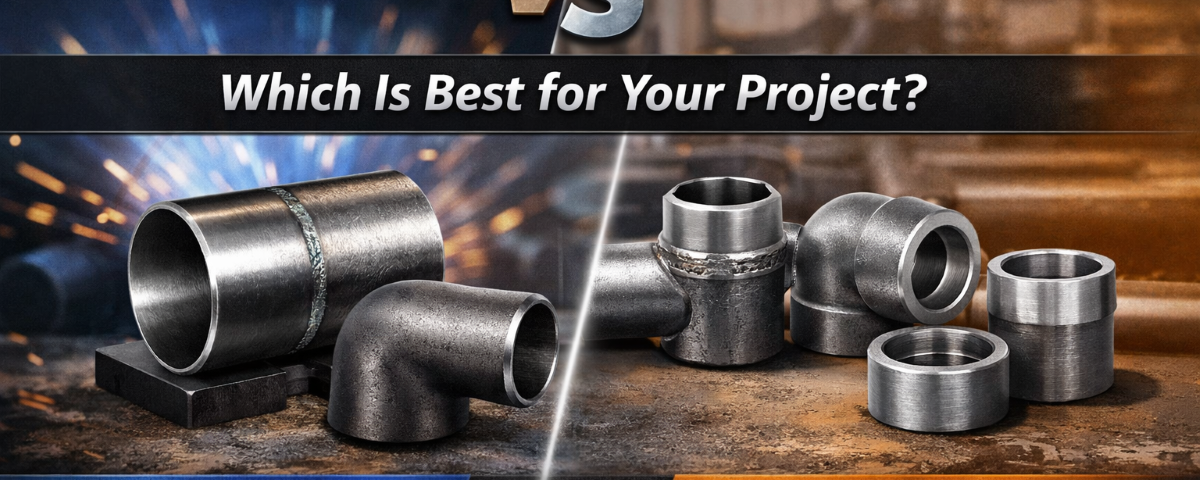
Choosing the right pipe fitting is not just a technical decision it directly affects pipeline safety, durability, and long-term operating costs. In industries such as oil & gas, power generation, infrastructure, and manufacturing, the debate between butt weld and socket weld fittings is common. Understanding their differences helps engineers, contractors, and procurement teams select the right solution for each project.
This guide explains the key differences, advantages, disadvantages, and real-world applications of both fitting types, while also highlighting considerations when sourcing steel pipe fitting in India through a reliable steel manufacturer agency in Mumbai or other industrial hubs.
What Are Butt Weld Pipe Fittings?
Butt weld fittings are joined by welding the beveled ends of pipes directly together, creating a continuous, full-penetration weld joint. This produces a seamless internal bore that maintains consistent flow characteristics across the pipeline.
Because the weld penetrates the entire pipe wall thickness, the joint can achieve strength comparable to the base material, making it suitable for demanding industrial applications.
Common Applications
- Oil and gas pipelines
- Petrochemical plants
- High-pressure steam lines
- Large-diameter industrial piping
- Power generation systems
What Are Socket Weld Pipe Fittings?
Socket weld fittings use a recessed socket where the pipe end is inserted before welding around the outer edge using a fillet weld. This design simplifies alignment and installation, particularly for smaller pipe diameters.
Socket weld fittings are typically used for small-bore piping systems where installation speed and ease are more important than maximum structural strength.
Common Applications
- Small-diameter piping (usually up to 2 inches)
- Hydraulic lines
- Instrumentation piping
- Utility pipelines in industrial plants
Key Differences Between Butt Weld and Socket Weld Fittings
| Feature | Butt Weld Fittings | Socket Weld Fittings |
| Joint Type | End-to-end full-penetration weld | Pipe inserted into socket and fillet welded |
| Strength | Very high, similar to base pipe | Moderate (single fillet weld) |
| Pipe Size | Suitable for all sizes | Typically small sizes (≤2 inches) |
| Flow Characteristics | Smooth internal bore | Small internal recess may create turbulence |
| Installation | Requires precise alignment and skilled welding | Easier alignment and faster installation |
| Inspection | Easy to inspect via RT/UT testing | Inspection more limited |
| Best For | High-pressure, high-temperature systems | Small-bore, moderate-pressure systems |
Advantages of Butt Weld Fittings
1. Superior Strength and Reliability
Because butt weld joints are full-penetration welds, they offer excellent mechanical strength and fatigue resistance, making them ideal for critical industrial systems.
2. Smooth Internal Flow
The continuous internal diameter reduces turbulence and pressure drop, improving hydraulic efficiency in large pipelines.
3. Better Performance in High Pressure and Temperature
Butt weld fittings distribute stress more evenly and perform better in systems exposed to thermal cycling or extreme pressure conditions.
4. Lower Long-Term Maintenance
Fewer crevices mean less risk of corrosion buildup or leakage over time, which helps reduce maintenance costs.
Advantages of Socket Weld Fittings
1. Faster Installation
The socket design automatically aligns pipes, simplifying installation and reducing setup time.
2. Cost-Effective for Small Piping
Socket weld fittings often require fewer welding passes and less labor, making them economical for small-diameter pipelines.
3. Reduced Leakage Compared to Threaded Connections
Unlike threaded joints, welded socket connections provide stronger sealing performance.
Disadvantages of Butt Weld Fittings
- Requires skilled welders and precise alignment
- Installation can take longer than socket welding
- Higher initial installation cost due to labor and inspection requirements
However, these disadvantages are often offset by long-term reliability in large-scale systems.
Disadvantages of Socket Weld Fittings
- Limited to small pipe sizes
- Lower structural strength compared to butt weld joints
- Internal crevice may trap fluids, potentially causing corrosion
- Not ideal for high-pressure or severe cyclic service conditions
Which One Should You Choose?
Choose Butt Weld Fittings When:
- The pipeline operates at high pressure or temperature
- Pipe diameter is large
- Long-term durability and reliability are critical
- Clean internal surfaces are required (e.g., chemical or food industries)
Choose Socket Weld Fittings When:
- Pipe diameter is small
- Installation speed is a priority
- The system operates at moderate pressure
- Cost savings on small piping systems are required
In many industrial projects, both fitting types are used togethersocket weld fittings for small-bore piping and butt weld fittings for main pipeline connections.
Importance of Selecting a Reliable Steel Pipe Fitting Supplier
Whether selecting butt weld or socket weld fittings, sourcing from a reliable supplier is crucial. Many contractors sourcing steel pipe fitting in India prefer working with an experienced steel manufacturer agency in Mumbai, as the region hosts a strong network of manufacturers, distributors, and export-oriented steel companies.
A trusted supplier ensures:
- Compliance with ASME/ASTM standards
- Material traceability and testing certificates
- Consistent product quality
- Timely delivery for project schedules
Selecting certified manufacturers or agencies significantly reduces the risk of pipeline failures and quality issues.
Industry Standards and Codes to Consider
Pipe fittings used in industrial piping systems are commonly governed by standards such as:
- ASME B16.9 (butt weld fittings)
- ASME B16.11 (socket weld fittings)
- ASME B31.1 / B31.3 piping codes
Following these standards ensures compatibility, safety, and regulatory compliance across industrial projects.
Practical Decision Tip (Engineer’s Rule of Thumb)
A simple rule often used in piping design:
- Small-bore pipes (≤2 inches): Socket weld
- Larger or critical pipelines: Butt weld
Of course, final selection depends on project specifications, operating conditions, and applicable codes.
Frequently Asked Questions (FAQs)
1. Which fitting is stronger: butt weld or socket weld?
Butt weld fittings are generally stronger because they use full-penetration welds that distribute stress more evenly across the joint.
2. Are socket weld fittings cheaper than butt weld fittings?
For small-diameter piping systems, socket weld fittings are usually cheaper due to faster installation and fewer welding requirements.
3. Can socket weld fittings be used in high-pressure pipelines?
They can be used in moderate-pressure systems, but high-pressure pipelines typically require butt weld fittings for better structural integrity.
4. Why are butt weld fittings preferred in large industrial projects?
They provide higher strength, smoother flow characteristics, and better long-term durability, making them suitable for large pipelines and critical systems.
5. Where can I source quality steel pipe fittings in India?
Major industrial hubs like Mumbai host several certified suppliers and distributor networks, making it easier to procure fittings through a reputable steel manufacturer agency in Mumbai.
Conclusion
Both butt weld and socket weld fittings play essential roles in modern piping systems. Butt weld fittings dominate high-pressure, large-diameter applications where durability and strength are paramount, while socket weld fittings offer a practical and economical solution for small-bore piping.
The best choice depends on project requirements, operating conditions, and compliance standards. By selecting the right fitting typeand sourcing from a reliable steel pipe fitting in India supplieryou can ensure pipeline safety, operational efficiency, and long-term performance.