- Get Free Quotes
- +91 99209 06048
- +91 22675 21290
- [email protected]

Forged Pipe Fittings Manufacturers in India: A Complete Buyer’s Guide
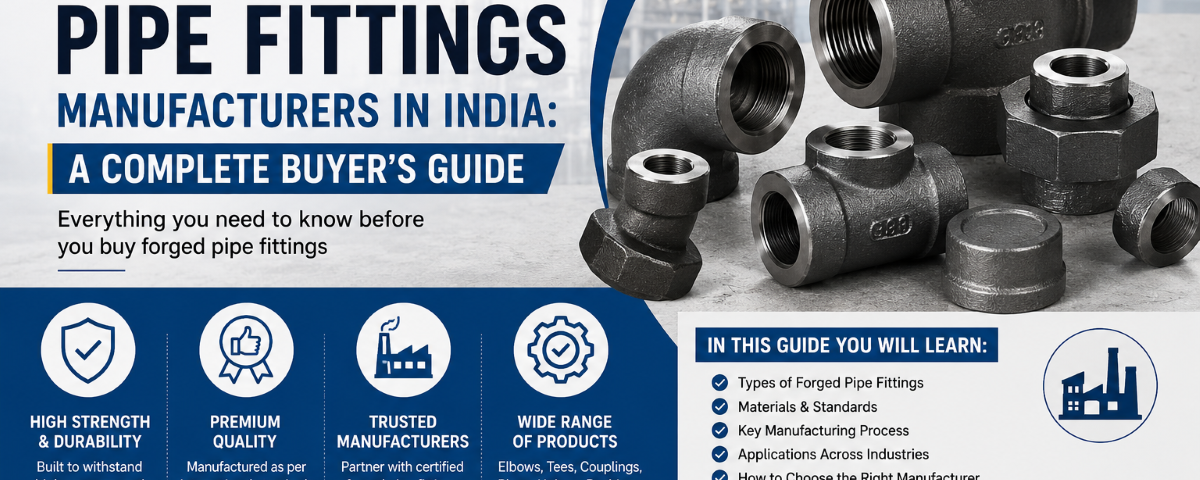
When selecting components for industrial piping systems, choosing the right fittings is essential for safety, performance, and long-term reliability. Forged pipe fittings are widely used in applications where high pressure, temperature, mechanical strength, and dimensional accuracy are important.
For businesses searching for reliable Forged Pipe Fittings Manufacturers in India, it is important to understand the available fitting types, materials, pressure ratings, connection methods, applicable standards, and selection criteria before placing an order.
For buyers comparing Forged Pipe Fittings Manufacturers in India, understanding these benefits can help in selecting the right supplier.
What Are Forged Pipe Fittings?
Forged pipe fittings are manufactured by shaping heated metal under controlled pressure. Unlike cast fittings, which are produced by pouring molten metal into a mould, forged fittings are formed using mechanical force to create a strong and dense metal structure.
This manufacturing process makes forged fittings suitable for demanding piping applications where strength and pressure resistance are important. They are used as pipe fittings to connect pipes, change flow direction, create branches, reduce connection sizes, or close piping sections.
Common products include forged fittings such as elbows, tees, couplings, crosses, caps, plugs, unions, and bushings.
Why Are Forged Pipe Fittings Used?
Forged fittings are preferred in many industrial applications because they provide a combination of strength, durability, and compact construction.
Key advantages include:
- High mechanical strength
- Good pressure resistance
- Reliable performance under demanding conditions
- Consistent dimensional accuracy
- Good fatigue resistance
- Compact design
- Suitable for high-pressure piping systems
- Long service life when correctly specified and installed
They are commonly used in industries such as oil and gas, petrochemical processing, refineries, power generation, chemical processing, pharmaceuticals, and general industrial manufacturing.
Major Forged Fittings Types
Forged Pipe Fittings Manufacturers in India offer different fitting types based on piping requirements, pressure class, material and connection method.
Forged Steel Elbow
A forged steel elbow is used to change the direction of a pipeline. Common configurations include 45-degree and 90-degree elbows.
Forged elbows are useful in compact piping systems where strength and reliable connections are required. The appropriate elbow should be selected according to pipe size, material, pressure class, connection type, and applicable standards.
Forged Steel Tee
A forged tee creates a branch connection from the main pipeline. Equal tees have the same run and branch size, while reducing tees connect pipes with different diameters.
They are commonly used in process piping, chemical plants, hydraulic systems, and industrial equipment.
Forged Steel Coupling
A forged steel coupling is used to connect two pipes or components in a straight line. Couplings are available in different connection configurations, including socket weld and threaded types.
They are particularly useful where compact connections are required.
Forged Cross
A forged cross provides four connection points and can be used where a piping system needs multiple branches. Selection depends on pipe dimensions, pressure requirements, material grade, and connection configuration.
Forged Caps and Plugs
Forged caps and plugs are used to close pipe ends or unused connections. They may be used during equipment isolation, maintenance, and piping modifications.
Forged Bushings
Forged bushings are used to connect components having different thread sizes. They are particularly useful in threaded piping arrangements where a reduction in connection size is required.
Materials Available for Forged Pipe Fittings
Which materials are forged fittings available in?
Forged pipe fittings are manufactured in several material grades to suit different operating environments. The correct material depends on pressure, temperature, corrosion conditions, fluid characteristics, and industry requirements.
Common materials include:
- Carbon steel
- Stainless steel
- Alloy steel
- Nickel alloys
- Duplex stainless steel
- Super duplex stainless steel
- Other specialized alloys
ASTM A105 forged fittings are widely specified for carbon steel pressure applications. Stainless steel forged fittings may be selected when corrosion resistance is a major requirement, while alloy steel can be suitable for applications involving elevated temperatures and demanding mechanical conditions.
When sourcing from Forged Pipe Fittings Manufacturers in India, buyers should confirm the material grade and applicable specifications.
ASTM A105 Forged Fittings
ASTM A105 forged fittings are manufactured from carbon steel forgings intended for pressure-containing piping applications.ASTM A105 is commonly associated with carbon steel pipe fittings used in industrial piping systems.
When purchasing these fittings, buyers should verify the material grade and applicable specification. Depending on project requirements, documentation may include material test certificates, heat numbers, chemical composition, mechanical properties, and inspection records.
When evaluating Forged Pipe Fittings Manufacturers in India, confirm that the manufacturer can provide the required material documentation and traceability.
Forged vs Buttweld Fittings
One of the most important questions for buyers is: What is the difference between forged and buttweld pipe fittings?
Forged fittings are manufactured through a forging process and are commonly supplied with socket weld or threaded connections. They are frequently used in smaller-diameter, high-pressure, and compact piping applications.
Buttweld fittings are designed to be welded directly to the pipe. They are widely used in larger-diameter process piping and applications where a continuous welded connection is required.
Forged vs Buttweld Fittings: Key Differences
| Feature | Forged Fittings | Buttweld Fittings |
| Manufacturing | Forging process | Forming process for butt-weld applications |
| Connection | Socket weld or threaded | Butt weld |
| Typical size range | Generally smaller sizes | Commonly used for larger pipe sizes |
| Application | Compact and high-pressure piping | Process and larger-diameter piping |
| Installation | Socket welding or threading | Direct welding to pipe |
| Space requirement | Compact connection | Requires welding space |
Neither type is universally better. The correct choice depends on pipe size, pressure, temperature, service conditions, connection requirements, installation method, and project specifications.
Socket Weld vs Threaded Forged Fittings
The choice between socket weld vs threaded forged fittings depends on the piping design and operating conditions.
Socket Weld Forged Fittings
Socket weld fittings are designed so that the pipe enters a recessed socket in the fitting. The connection is then welded.
They may be preferred when:
- High-pressure service is involved
- A permanent connection is required
- Compact piping is important
- Welding facilities are available
- The project specification requires socket weld connections
Socket weld fittings are commonly used in industrial piping where reliable, compact connections are required.
Threaded Forged Fittings
Threaded forged fittings use internal or external threads to create the connection without welding. They can be useful where easy installation and disassembly are important.
They may be suitable when:
- Welding is not preferred
- Easy installation is required
- Maintenance access is important
- The application permits threaded connections
- Frequent dismantling may be required
The connection type should always be compatible with the pressure class, service conditions, applicable piping code, and project requirements.
Understanding Forged Fitting Pressure Rating
A forged fitting pressure rating indicates the pressure capability of a fitting under specified conditions. However, the pressure rating should not be evaluated separately from material and temperature.
Forged socket weld and threaded fittings may be available in pressure classes such as 2,000, 3,000, 6,000, and 9,000, depending on the applicable standard and product configuration.
The allowable pressure can be affected by:
- Material grade
- Operating temperature
- Nominal pipe size
- Pressure class
- Wall thickness
- Applicable standard
- Service or fluid conditions
Reputable Forged Pipe Fittings Manufacturers in India can provide product information and documentation required for pressure-rated applications.
Therefore, buyers should select pressure class according to the complete engineering specification rather than simply choosing the highest available rating.
Standards for Forged Pipe Fittings
What standards govern forged pipe fitting dimensions?
Several ASME and ASTM standards may apply to forged pipe fittings depending on the product type, material, and application.
Important specifications include:
- ASME B16.11 – Forged fittings, socket-welding and threaded
- ASTM A105 – Carbon steel forgings for piping applications
- ASTM A182 – Forged or rolled alloy and stainless steel flange and fitting applications
- ASME B16.5 – Pipe flanges and flanged fittings, where applicable
ASME B16.11 is particularly important for buyers of socket weld and threaded forged fittings because it covers relevant dimensions and requirements.
Before ordering, always confirm the required standard, material grade, pressure class, dimensions, and connection type.
Buyers should discuss these requirements with Forged Pipe Fittings Manufacturers in India before finalizing the order.
What Size Forged Pipe Fitting Should You Buy?
What is the maximum size available for forged pipe fittings?
The available size depends on the fitting type, material, pressure class, manufacturer, and applicable standard. Forged fittings are generally more common in smaller nominal pipe sizes, while larger process piping applications often use buttweld fittings.
Some manufacturers may also provide special or custom sizes according to engineering drawings and project requirements.
Before requesting a quotation, provide the manufacturer with:
- Nominal pipe size
- Schedule or wall thickness
- Fitting type
- Material grade
- Connection type
- Pressure class
- Applicable standard
- Required quantity
Providing complete specifications helps manufacturers supply the correct fitting and reduces the risk of compatibility issues during installation.
How to Choose Forged Pipe Fittings Manufacturers in India
Choosing the right supplier is an important part of industrial procurement. When comparing Forged Pipe Fittings Manufacturers in India, buyers should consider more than product price.
Manufacturing Capability
Look for manufacturers with appropriate forging, machining, heat treatment, and finishing capabilities. A suitable manufacturing setup can help maintain product consistency and dimensional accuracy.
Material Traceability
Material traceability is essential for many industrial applications. Check whether the manufacturer can provide heat numbers, material certificates, and other required documentation.
Quality Inspection
The manufacturer should have suitable inspection procedures for dimensions, surface quality, material properties, and other requirements specified in the purchase order.
Standards Compliance
Confirm that the fittings are manufactured according to the required ASME, ASTM, or project-specific standards. Standard compliance should be verified through product documentation.
Product Range
A manufacturer offering forged elbows, tees, couplings, crosses, caps, plugs, bushings, and other fittings can simplify procurement for projects requiring multiple components.
Custom Manufacturing
Some industrial projects require special dimensions, materials, markings, or inspection procedures. A manufacturer with custom manufacturing capabilities can be useful for project-specific requirements.
Applications of Forged Pipe Fittings
Forged Pipe Fittings Manufacturers in India supply fittings for a wide range of industrial applications where reliable piping connections are required.
Oil and Gas Industry
Forged fittings can be used in high-pressure process lines, instrumentation systems, pipelines, and related equipment.
Petrochemical and Refinery Applications
They are commonly used in process piping where pressure, temperature, mechanical strength, and material compatibility are important.
Power Generation
Forged fittings may be used in steam, water, fuel, and utility systems depending on the required material and design.
Chemical Processing
Chemical processing facilities require fittings that can withstand the specific pressure, temperature, and corrosion conditions of the application.
Pharmaceutical and Industrial Plants
Forged fittings can also be used in compact process piping and utility connections where dimensional accuracy and reliable connections are required.
Buyer’s Checklist for Forged Pipe Fittings
When selecting Forged Pipe Fittings Manufacturers in India, buyers should check material traceability, applicable standards, inspection procedures and product documentation.
- Fitting type
- Nominal pipe size
- Material grade
- Pressure class
- Socket weld or threaded connection
- Applicable standard
- End connection requirements
- Heat treatment requirements
- Surface finish
- Marking requirements
- Material Test Certificate requirements
- Inspection requirements
- Quantity and delivery schedule
Providing these details at the quotation stage helps the manufacturer understand the exact product requirement and reduces the possibility of ordering an unsuitable fitting.
Frequently Asked Questions
What is the difference between forged and buttweld pipe fittings?
Forged fittings are manufactured through forging and commonly use socket weld or threaded connections, particularly in smaller and high-pressure piping systems. Buttweld fittings are designed to be welded directly to pipes and are commonly used in larger process piping systems.
Which materials are forged fittings available in?
Forged fittings are available in carbon steel, stainless steel, alloy steel, nickel alloys, duplex stainless steel, super duplex stainless steel, and other specialized alloys. Material selection depends on pressure, temperature, corrosion resistance, and service conditions.
What is the maximum size available for forged pipe fittings?
The maximum size depends on the fitting type, material, pressure class, manufacturer, and applicable standard. Forged fittings are generally more common in smaller pipe sizes, while larger piping systems frequently use buttweld fittings. Special sizes may also be available based on project requirements.
How do socket weld and threaded forged fittings differ?
Socket weld forged fittings use a welded connection in which the pipe is inserted into the fitting socket. Threaded forged fittings use mechanical threads to connect the components. Socket weld fittings are commonly selected for permanent connections, while threaded fittings can provide easier installation and disassembly where permitted.
What standards govern forged pipe fitting dimensions?
ASME B16.11 is a key standard for forged socket-welding and threaded fittings. Material specifications such as ASTM A105 and ASTM A182 may also apply depending on the material and application. Buyers should confirm the exact standard required for their project before ordering.