- Get Free Quotes
- +91 99209 06048
- +91 22675 21290
- [email protected]

Carbon Steel Flanges Suppliers in India: Types, Grades and How to Choose the Right One
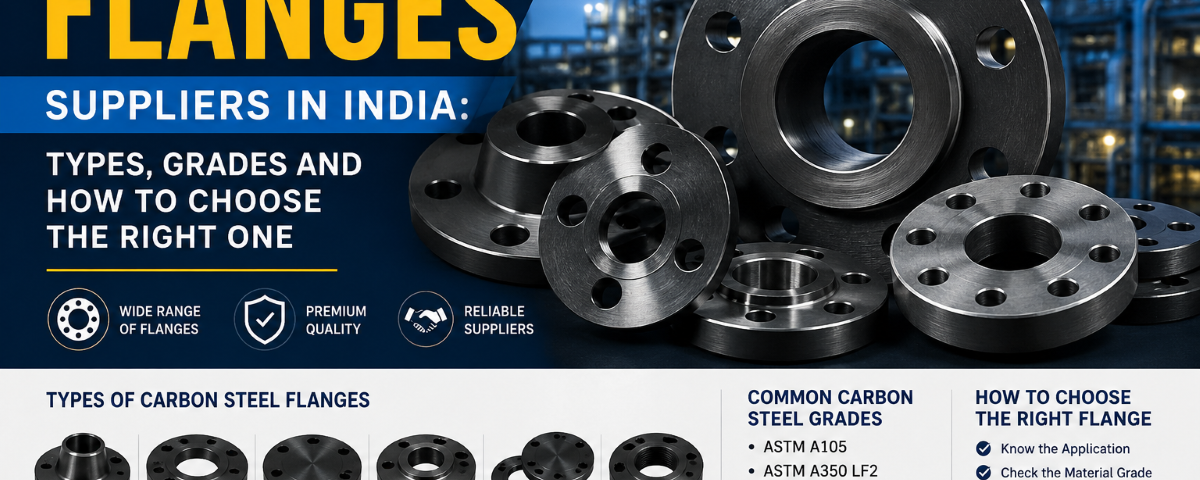
Choosing the right flange is essential for creating safe, reliable, and leak-resistant connections in industrial piping systems. Carbon steel flanges are widely used across oil and gas, petrochemical, power generation, chemical processing, water treatment, and manufacturing industries because of their strength, durability, and cost-effectiveness.
For businesses looking for reliable Carbon Steel Flanges Suppliers in India, understanding flange types, material grades, dimensions, pressure classes, and applicable standards is important before placing an order.
The right flange depends on several factors, including pipe size, pressure, temperature, material grade, connection type, and application requirements. This guide explains the different carbon steel flange types, commonly used grades such as ASTM A105, flange dimensions and standards, pressure classes, and how to select the right flange for your piping system.
What Are Carbon Steel Flanges?
Carbon steel flanges are mechanical components used to connect pipes with other pipes, valves, pumps, fittings, and equipment. They typically create a detachable joint using bolts and a gasket, making inspection, maintenance, and replacement easier.
Compared with permanent welded connections, flanged connections provide greater accessibility when pipeline components need to be removed or serviced.
Carbon steel flanges are available in different designs, sizes, pressure ratings, material grades, and facing configurations. For specific product requirements, explore our Carbon Steel Flange Manufacturer in India solutihttp://Carbon steel flanges are available in different designs, sizes, pressure ratings, material grades, and facing configurations. For specific product requirements, explore our Carbon Steel Flange Manufacturer in India solutions.ons.
Types of Carbon Steel Flanges
Understanding the different carbon steel flange types helps buyers select the appropriate flange according to the pipeline’s design and operating requirements.
1. Carbon Steel Weld Neck Flanges
A carbon steel weld neck flange has a long tapered hub and is attached to the pipe through butt welding. Its design helps distribute stress more effectively between the flange and pipe.
Weld neck flanges are commonly selected for high-pressure, high-temperature, and demanding industrial applications where strength and long-term reliability are important.
2. Carbon Steel Slip-On Flanges
Slip-on flanges are designed to slide over the pipe and are then welded into position. They are relatively simple to install and can be an economical option for suitable low- to medium-pressure applications.
3. Carbon Steel Blind Flanges
Blind flanges are solid flanges without a central opening. They are used to close pipe ends, valves, pressure vessels, and pipeline sections.
They are particularly useful for pipeline isolation, maintenance, pressure testing, and future expansion.
4. Carbon Steel Socket Weld Flanges
Socket weld flanges feature a recessed area where the pipe is inserted before welding. They are generally used for smaller-diameter piping systems that require a strong and secure connection.
5. Carbon Steel Threaded Flanges
Threaded flanges have internal threads that connect with externally threaded pipes. They can be used where welding is difficult or unsuitable, depending on the application’s pressure, temperature, and safety requirements.
6. Carbon Steel Lap Joint Flanges
Lap joint flanges are used with stub ends and can rotate around the pipe. This feature can simplify bolt-hole alignment and make them useful in applications where frequent dismantling is required.
Carbon Steel Flange Grades: ASTM A105
Material grade is a key consideration when selecting a carbon steel flange. ASTM A105 is one of the commonly specified material standards for forged carbon steel piping components, including flanges and fittings.
ASTM A105 carbon steel flanges are widely used in pressure-containing piping systems and can be found in industries such as:
- Oil and gas
- Refineries
- Petrochemical
- Power generation
- Chemical processing
- Water treatment
- Industrial manufacturing
The appropriate material specification should always be selected according to the project’s design requirements, operating conditions, applicable standards, and engineering specifications.
A105 vs A106: Which Is Used for Flanges?
A common question when selecting carbon steel components is whether ASTM A105 or ASTM A106 should be used.
ASTM A105 is commonly associated with forged carbon steel components such as flanges and fittings. ASTM A106 primarily covers seamless carbon steel pipe intended for high-temperature service.
Therefore, A105 and A106 are different material specifications intended for different product forms. For a forged carbon steel flange, the required material specification should be confirmed according to the project specification and applicable standard.
Carbon Steel Flange Dimensions and Standards
Correct flange dimensions are essential for ensuring compatibility between the flange, pipe, gasket, and mating component.
Depending on the application and project requirements, carbon steel flanges may be manufactured according to recognized ASME, ANSI, Indian, or other applicable standards.
When checking carbon steel flange dimensions IS/ANSI, important dimensions may include:
- Nominal pipe size
- Outside diameter
- Bore diameter
- Flange thickness
- Bolt circle diameter
- Number of bolt holes
- Bolt hole diameter
- Facing dimensions
- Overall flange dimensions
Flange dimensions can vary depending on the applicable standard, nominal size, pressure class, and flange type. Therefore, the required standard should always be confirmed before purchasing.
CS Flange Specification Chart
A CS flange specification chart provides a convenient way to review the primary specifications before selecting a product.
| Specification | Common Options / Details |
| Material | Carbon Steel |
| Common Grade | ASTM A105 |
| Flange Types | Weld Neck, Slip-On, Blind, Socket Weld, Threaded, Lap Joint |
| Pressure Classes | 150, 300, 600, 900, 1500, 2500 |
| Standards | ASME/ANSI and applicable project standards |
| Facing | Raised Face, Flat Face and other applicable types |
| Size | Based on Nominal Pipe Size |
| Applications | Oil & Gas, Petrochemical, Power, Chemical, Water & Industrial Piping |
The exact dimensions, tolerances, pressure-temperature ratings, and material requirements should be verified against the relevant standard and manufacturer documentation.
What Pressure Classes Are Available in Carbon Steel Flanges?
Carbon steel flanges are manufactured in various pressure classes to accommodate different operating conditions. Common ASME pressure classes include:
- Class 150
- Class 300
- Class 600
- Class 900
- Class 1500
- Class 2500
However, a pressure class should not be interpreted as one fixed allowable pressure under every condition. The allowable working pressure can vary depending on material grade and operating temperature.
For this reason, engineers should check the applicable pressure-temperature rating before selecting a flange.
Carbon Steel vs Stainless Steel Flanges
Carbon steel and stainless steel flanges are both widely used, but they offer different characteristics.
| Factor | Carbon Steel Flanges | Stainless Steel Flanges |
| Strength | High | High |
| Corrosion Resistance | Moderate | Generally higher |
| Cost | Generally economical | Generally higher |
| Industrial Applications | Wide range | Wide range |
| Corrosive Service | May require protection | Often preferred |
| Material Selection | Suitable for many general applications | Suitable where corrosion resistance is important |
Carbon steel can be a cost-effective choice for many industrial piping systems. Stainless steel may be preferred when the pipeline is exposed to corrosive fluids or environments.
The final material selection should be based on pressure, temperature, fluid composition, corrosion conditions, and project requirements.
How to Choose the Right Carbon Steel Flange for Your Pipeline?
Selecting a flange involves more than matching the pipe diameter. Consider the following factors before purchasing.
Buyers who require complete piping components can also explore our Pipe Fittings Manufacturer in India range.
1. Determine the Pipe Size
Identify the nominal pipe size and outside diameter. The flange bore and other dimensions should be compatible with the pipeline.
2. Check Operating Pressure and Temperature
Determine the maximum operating pressure and temperature of the system. Select a suitable flange pressure class and material based on the applicable pressure-temperature ratings.
3. Select the Material Grade
ASTM A105 is commonly used for forged carbon steel flanges, but the exact material specification should be determined according to the project’s engineering requirements.
4. Choose the Correct Flange Type
The flange design should match the installation and operating requirements. For example, weld neck flanges are commonly used in demanding services, while slip-on flanges may be appropriate for certain less demanding applications.
5. Verify the Flange Facing
Check that the flange facing is compatible with the mating flange and gasket. Raised face and flat face configurations are commonly used depending on the application.
6. Confirm Dimensions and Standards
Verify the required flange standard, bolt-hole pattern, bore, outside diameter, thickness, and other dimensions before ordering.
7. Consider the Operating Environment
Fluid characteristics, corrosion, vibration, mechanical loads, temperature fluctuations, and maintenance requirements should all be considered when selecting the flange.
How Do I Identify the Correct Flange Size for My Pipeline?
To identify the correct flange size, start with the pipeline’s nominal pipe size and determine the applicable flange standard and pressure class.
Before ordering, verify:
- Nominal pipe size
- Pipe outside diameter
- Flange bore
- Outside diameter
- Flange thickness
- Bolt-hole diameter
- Number and arrangement of bolt holes
- Pressure class
- Facing type
- Applicable manufacturing standard
For critical industrial applications, these details should be checked against approved engineering drawings and piping specifications.
Are Carbon Steel Flanges Suitable for High-Temperature Applications?
Yes, carbon steel flanges can be used in many high-temperature applications when the correct material, flange design, and pressure-temperature rating are selected.
Temperature can affect the allowable working pressure of a flange. Therefore, choosing a flange only by its nominal pressure class may not be sufficient.
For high-temperature applications, verify the material grade, operating temperature, operating pressure, applicable standard, and manufacturer’s technical documentation before installation.
Applications of Carbon Steel Flanges
Carbon steel flanges are commonly used in several industries, including:
- Oil and gas
- Refineries
- Petrochemical plants
- Power generation
- Chemical processing
- Water treatment
- Process industries
- Industrial manufacturing
- Utility piping
- Pressure equipment
Their combination of mechanical strength, availability, and cost-effectiveness makes them suitable for a wide variety of industrial piping requirements.
How to Choose Carbon Steel Flanges Suppliers in India?
Choosing the right Carbon Steel Flanges Suppliers in India is important for ensuring that the supplied products meet the required technical and quality specifications.
Instead of comparing suppliers only by price, consider factors such as:
- Product range
- Material grades
- Flange sizes
- Pressure classes
- Manufacturing standards
- Quality control
- Testing and inspection
- Material documentation
- Product traceability
- Delivery capability
- Technical support
An experienced carbon steel flange manufacturer India should be able to provide suitable flange options based on the required size, material, pressure rating, standard, and application.
Frequently Asked Questions About Carbon Steel Flanges
What is the difference between carbon steel and stainless steel flanges?
Carbon steel flanges generally provide high strength at a comparatively economical cost, while stainless steel flanges offer greater corrosion resistance in many environments. The appropriate choice depends on the fluid, temperature, pressure, corrosion conditions, and application.
Which grade of carbon steel is used for flanges, A105 or A106?
ASTM A105 is commonly used for forged carbon steel flanges. ASTM A106 is primarily a specification for seamless carbon steel pipe used for high-temperature service. Therefore, A105 is generally the more relevant specification for forged flanges.
What pressure classes are available in carbon steel flanges?
Common pressure classes include Class 150, 300, 600, 900, 1500, and 2500. The appropriate class depends on the material, operating pressure, temperature, and applicable design standard.
How do I identify the correct flange size for my pipeline?
Identify the nominal pipe size, outside diameter, flange bore, bolt-hole arrangement, pressure class, facing type, and applicable standard. These details should be cross-checked with the project’s piping specifications before ordering.
Are carbon steel flanges suitable for high-temperature applications?
Carbon steel flanges can be suitable for many high-temperature applications when the correct material grade and pressure-temperature rating are selected. Always verify the allowable rating for the actual operating temperature and pressure.
Conclusion
Selecting the correct flange is essential for achieving a secure, reliable, and efficient piping connection. With multiple carbon steel flange types, material grades, pressure classes, dimensions, and facing options available, the selection should always be based on the specific requirements of the pipeline.
ASTM A105 is a commonly specified material for forged carbon steel flanges, while applicable ASME, ANSI, IS, and project standards help determine dimensions and other technical requirements. Pipe size, operating pressure, temperature, fluid characteristics, flange type, and corrosion conditions should also be evaluated before purchasing.
For businesses searching for dependable Carbon Steel Flanges Suppliers in India, working with an experienced supplier or carbon steel flange manufacturer India can help ensure appropriate product selection, consistent quality, accurate dimensions, and reliable documentation.
Whether you need a carbon steel weld neck flange, slip-on flange, blind flange, socket weld flange, or another configuration, always verify the complete technical specification before installation. The right flange selection can contribute to safer pipeline operation, better compatibility, and long-term system performance.