- Get Free Quotes
- +91 99209 06048
- +91 22675 21290
- [email protected]

How to Verify Quality of Steel Before Purchase (Expert Guide)
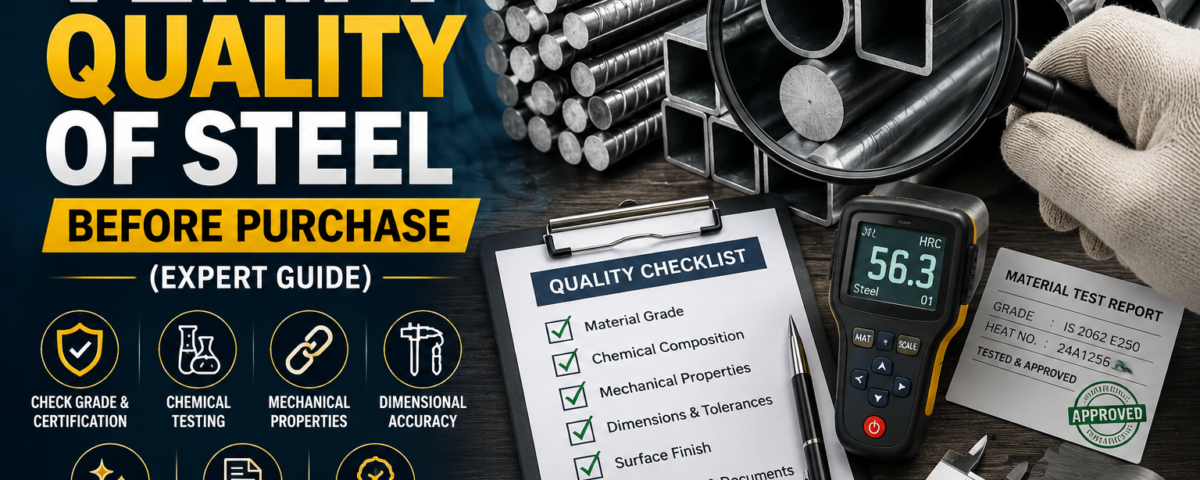
Buying steel isn’t just a transaction, it’s a decision that directly impacts safety, durability, and long-term costs. Whether you’re sourcing material for construction, fabrication, or industrial use, a poor choice can lead to structural failure, delays, and expensive rework.
This expert-led steel buying guide will help you understand how to perform a reliable steel quality check in India step by step, without guesswork.
Why Steel Quality Matters More Than Price
It’s tempting to choose the lowest quote. But in steel procurement, cheaper often means compromised quality.
Low-grade steel can result in:
- Reduced strength and load-bearing capacity
- Faster corrosion and wear
- Welding and fabrication issues
- Safety risks in structural applications
In India, quality standards exist for a reason. Following them protects both your project and your reputation.
1. Check for ISI Certification and Standards Compliance
The first and most basic step in any steel quality check in India is verifying certification.
Look for compliance with standards set by the Bureau of Indian Standards (BIS).
What to verify:
- ISI mark on the product
- Grade specification (e.g., Fe 500, Fe 550 for TMT bars)
- Manufacturer’s identification mark
These standards ensure the steel meets minimum requirements for strength, ductility, and chemical composition.
👉 Tip: If a supplier hesitates to show certification, treat it as a red flag.
2. Ask for a Material Test Certificate (MTC)
A Material Test Certificate is not optionalit’s essential.
An MTC provides verified data about:
- Chemical composition
- Mechanical properties (yield strength, tensile strength)
- Heat number and traceability
Reputable manufacturers follow testing guidelines aligned with organizations like ASTM International.
Why it matters:
It confirms that the steel you’re buying matches the required specificationsnot just visually, but scientifically.
3. Perform a Visual Inspection (Yes, It Still Matters)
Even with certifications, a physical check is important.
Look for:
- Surface cracks or irregularities
- Rust, scaling, or corrosion
- Uniform shape and size
- Clean finish without deformities
Good quality steel should look consistent and well-finished. Visible defects often indicate poor manufacturing or improper storage.
4. Check Weight and Dimensions
Steel products must meet standard weight and size specifications.
Why this matters:
Underweight steel is a common issue in the market and it directly affects strength.
What to do:
- Use a weighing scale to verify actual weight
- Compare with standard charts (BIS specifications)
- Measure diameter and thickness accurately
Even small deviations can impact structural performance.
5. Verify Chemical Composition
Steel is not just metalit’s a carefully balanced alloy.
Key elements include:
- Carbon
- Manganese
- Sulfur
- Phosphorus
Incorrect composition can make steel brittle or weak.
How to check:
- Review the MTC
- Request third-party lab testing if required
For critical projects, this step is non-negotiable.
6. Conduct Mechanical Tests (If Applicable)
For large or high-risk projects, mechanical testing provides deeper assurance.
Common tests include:
- Tensile strength test
- Bend and rebend test
- Impact resistance test
These tests confirm how steel behaves under stresssomething visual checks cannot reveal.
7. Buy from Reputed and Verified Suppliers
Even the best testing won’t help if your supplier is unreliable.
Choose suppliers who:
- Provide full documentation
- Have a proven track record
- Follow industry standards
Working with trusted vendors reduces risk significantly.
8. Check for Corrosion Resistance
If your project involves exposure to moisture, chemicals, or outdoor conditions, corrosion resistance is critical.
According to the National Association of Corrosion Engineers, corrosion is one of the leading causes of material degradation in industrial environments.
What to consider:
- Use galvanized or stainless steel where required
- Check coating quality
- Ensure proper storage before use
9. Inspect Packaging and Storage Conditions
Steel quality can degrade if stored improperly even if it was perfect at the factory.
Watch out for:
- Exposure to rain or moisture
- Improper stacking
- Dirt or contamination
Good suppliers maintain proper storage to preserve material integrity.
10. Avoid “Too Good to Be True” Deals
If the price seems unusually low, there’s usually a reason.
Common risks include:
- Substandard material
- Incorrect grade
- Fake or misleading certification
A smart steel buying guide always prioritizes value over cost.
Common Mistakes Buyers Make
Even experienced buyers slip up. Here are the most frequent errors:
Ignoring Documentation
Skipping MTC or certification checks.
Buying Only on Price
Choosing cheaper steel without verifying quality.
Not Testing Material
Relying solely on supplier claims.
Overlooking Storage Conditions
Quality can degrade before usage.
Avoiding these mistakes can save significant time and money.
Quick Checklist for Steel Quality Verification
Before finalizing your purchase, run through this:
✔ ISI/BIS certification verified
✔ Material Test Certificate reviewed
✔ Visual inspection completed
✔ Weight and dimensions checked
✔ Supplier credibility confirmed
✔ Corrosion resistance considered
If all boxes are checked you’re on the right track.
FAQs
How do you check steel quality before buying?
Verify certification, review the Material Test Certificate, inspect visually, and confirm weight and dimensions.
What is the ISI mark in steel?
It indicates compliance with standards set by the Bureau of Indian Standards, ensuring minimum quality requirements.
Why is MTC important in steel purchase?
It provides verified data on chemical and mechanical properties, ensuring authenticity.
How can I avoid buying low-quality steel?
Buy from reputed suppliers, check certifications, and avoid unusually low prices.
What tests are done to check steel quality?
Common tests include tensile strength, bend test, and chemical composition analysis.
Final Thoughts: Buy Smart, Build Strong
Steel is the backbone of any structure. Compromising on its quality is never worth the risk.
A proper steel quality check in India doesn’t require advanced expertise, it requires awareness, attention, and the willingness to verify.
Follow this steel buying guide, ask the right questions, and work with reliable suppliers.
Because in construction and manufacturing, quality isn’t just a feature
it’s the foundation of everything you build.